A Shipping Container's Long Chain of Handovers
A shipping container’s chain of handovers shows what ships, ports, rail links, and warehouses each do, so the journey from departure to delivery makes sense.
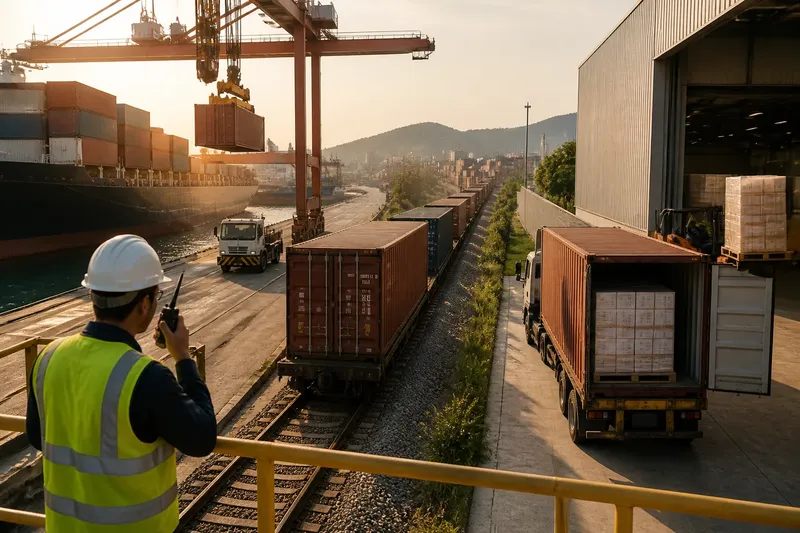
A shipping container’s journey depends on a chain of handovers, not on a ship doing everything. A ship carries it across water; a port transfers it between systems; a rail link moves it inland; and a warehouse receives, sorts, or prepares it for delivery. Each part solves a different problem, and each handover creates a point where timing and information must line up.
Follow one invented container of boxed ceramic tiles from a factory near a coastal port to a store inland. The tiles do not change their basic purpose as they travel, but the people and equipment responsible for them do. That is the useful way to read a freight route: as a sequence of jobs, rather than one long movement.
What does the ship do that the port cannot?
The ship handles the long water crossing. Its capacity makes it suited to carrying many containers between coastal regions, but it does not collect a box from a factory or place it on a store’s receiving dock. Those tasks belong to the links before and after the voyage.
Before departure, the container must be identified, assigned to a vessel, and brought to the port’s container yard. A shipping line plans the vessel’s route and loading arrangement. The container’s booking and cargo details help connect the physical box to the instructions that tell port staff where it should go.
At sea, the ship’s role is comparatively narrow: transport the loaded container to the next port. It follows a route shaped by port calls, weather, navigation, and vessel operations. The container may remain sealed, but its records still matter. A change in arrival timing can affect onward rail reservations or warehouse receiving plans.
For the tile shipment, the vessel carries the box from its departure port to a destination port. It does not make the tiles ready for retail; it gets them across the water.
Why is the port a transfer point, not just a dock?
A port is a working interchange between sea transport and land transport. Cranes move containers between ship and quay, while yard equipment places them in temporary storage or positions them for the next leg. Terminals also manage gates, records, inspections, and the order in which containers can be collected.
That temporary stay is not wasted motion. The ship and the rail service do not necessarily arrive at the same moment, and containers must be sorted into workable groups. A box may wait in a terminal yard until its rail slot, customs clearance, or collection arrangement is ready. The yard is therefore both a buffer and a place where a small documentation mismatch can hold up a physical load.
The port also marks a change in responsibility. The vessel operator’s task ends as the container is discharged, while terminal operators coordinate its movement within the port. A trucking or rail operator then takes over under the relevant release arrangements. The container is still the same box, but its next move depends on a new set of instructions.
In the tile shipment, the port unloads the container, records its location, and makes it available for inland transfer. The port does not simply “send it onward”; it makes the onward move possible.
How does the rail link change the journey?
Rail carries the container away from the coast toward an inland terminal or distribution area. It can connect a busy seaport with places that are not close to navigable water, using scheduled trains rather than extending the sea voyage by road. The rail leg is useful only if the container can reach the train, fit the service plan, and be collected at the other end.
At the destination rail terminal, the container is lifted off the train and prepared for another transfer. A truck may take it to a warehouse, or a nearby facility may receive it directly. Rail does not usually solve the final delivery by itself; it changes the container’s location to a point from which local distribution can take over.
Say the tile container arrives at the port after its planned train has left. The port may hold it for a later departure, and the inland terminal may need to adjust its receiving plan. The observable result is a shifted handover, not a mysterious pause in “shipping.” The delay belongs to the connection between services, even though the box remains in one place.
When reading a route, ask where the rail leg begins and ends. “By rail” is not a full delivery description; the terminals and the final connection matter.
What happens when the container reaches a warehouse?
A warehouse receives the container for a different reason than a port or rail terminal. It may unload the cargo, check it against shipping documents, sort it for orders, store it, or prepare it for onward delivery. Some facilities handle only a transfer; others manage inventory and fulfillment as well.
For the boxed tiles, warehouse staff may verify the shipment’s contents and condition, then move the cartons into a storage area or assign them to a store order. The container itself may be returned to a depot or reused on another journey. The goods continue through distribution, but the container’s role as their transport enclosure may end here.
Receiving capacity matters. If a warehouse cannot accept the load when it arrives, the container may need to wait elsewhere or be redirected according to the arrangements in place. The warehouse is not a passive endpoint: its hours, dock space, handling equipment, and inventory process shape what “delivered” means.
Ask whether delivery means arrival at a terminal, arrival at the warehouse gate, unloading, or acceptance into inventory. Those are different milestones.
Which questions clarify each handover?
Who is responsible for the container at each stage?
Responsibility can shift among the shipping line, port terminal, rail operator, truck carrier, and cargo owner or their agent. The transport documents and service agreement identify the relevant arrangements for a particular shipment.
What does “arrived” mean on a tracking page?
It may refer to arrival at a port, discharge from a vessel, arrival at a rail terminal, or receipt at a warehouse. Check the event name and location rather than treating every arrival notice as delivery to the final destination.
Why can a container wait after a ship arrives?
It may need to be unloaded, cleared for release, matched to an inland service, or collected within the terminal’s operating arrangements. A ship’s arrival is one event in the chain, not proof that the next carrier has already taken the box.
What details should a receiver confirm?
Confirm the delivery location, receiving window, unloading responsibility, and the documents or release details required for collection. Requirements vary by shipment and location, so the applicable carrier instructions and local rules determine the specifics.
How can you read a route as a sequence of jobs?
To understand a container’s movement, map the physical handovers alongside the places where its status changes:
- Factory to departure port: identify who brings the packed container to the terminal.
- Port to ship: note when the terminal records the load as ready and when it is placed aboard.
- Ship to destination port: distinguish vessel arrival from container discharge and release.
- Port to rail: identify the inland terminal and the party arranging the transfer.
- Rail terminal to warehouse: check who collects the container and how the warehouse receives it.
- Warehouse onward: clarify whether the container is unloaded, stored, or sent directly to another destination.
This route map makes the shipping container’s chain of handovers legible. A ship crosses the water, a port organizes the change of mode, rail carries the load inland, and a warehouse turns a transport arrival into usable stock. The practical question is not only where the box is, but which party has the next job and what event counts as that job being complete.