Letters, Songs and Recipes Keep Migrant Ties Alive Across Distance
Letters, songs and recipes help families sustain migrant ties across distance, with simple exchanges that carry memories and make room for change.
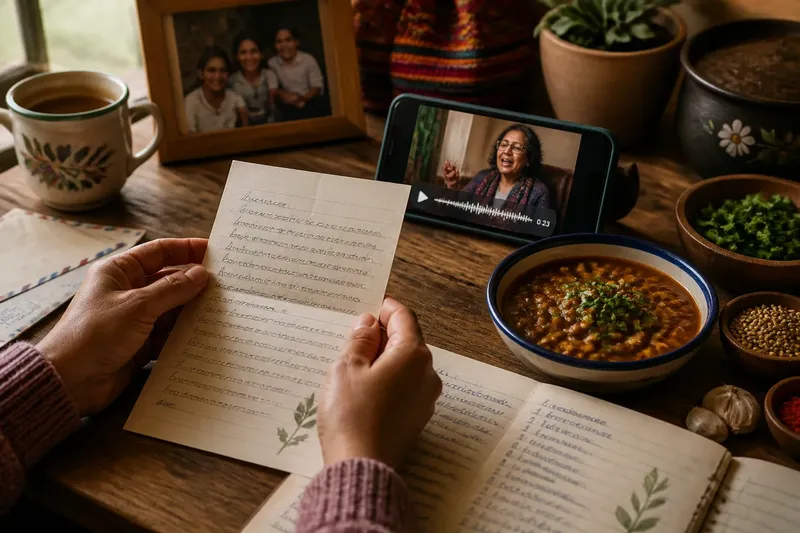
Letters, songs and recipes help families sustain migrant ties across distance by giving relatives something familiar to share and adapt. A handwritten note, a voice message of an old song, or instructions for a family dish can carry affection across a border without pretending life on either side has stayed the same.
These practices work less like preserved keepsakes than recurring conversations. The useful question is not whether a custom remains unchanged, but how people keep recognizing one another through it.
What can a letter carry that a quick message cannot?
A letter gives a relationship room to unfold. The writer can describe a new apartment, mention a neighbor, or return to a small shared memory without requiring an immediate answer. The recipient can read it at a chosen pace, keep it nearby, and return to a sentence later.
That slower rhythm matters when daily routines differ. A relative may be free to write on a weekend, while the person receiving the letter is working or caring for children. Paper does not demand that both people be available at once. Email and messaging apps can serve a similar purpose when people write longer notes instead of relying only on brief updates.
Letters also make change visible. A child’s handwriting grows more confident; a familiar place acquires a new name; the writer’s everyday language shifts. Those details are not distractions from the relationship. They show how it is being lived now.
Say a daughter living abroad starts sending her aunt notes about meals, errands, and the garden on her balcony. She includes one question about her aunt’s week. The exchange can develop into a shared routine, with specific details for each person to answer.
Choose a format the recipient can comfortably use, then make the invitation easy to answer.
How can songs connect generations without freezing tradition?
A song can be a compact piece of shared memory: its tune is easy to recognize, while each person may attach a different story to it. Singing together on a call, sending a recording, or trading verses can create a point of connection even when people do not share the same daily surroundings.
Children may learn the melody from an older relative but change a word, add a verse, or sing it in a different language. Rather than treating every variation as a mistake, families can ask what the change reflects. Perhaps a word has become unfamiliar, or a child has found a way to make the song fit a new setting. Continuity can include that kind of adjustment.
Recorded music is useful, but the human voice often carries the surrounding context: a pause, a laugh, a remembered name, or a correction. A relative can explain when a song was sung and who usually began it. That explanation helps listeners understand the practice as part of a relationship, not as a tune detached from the people who shared it.
There is no need to make a performance out of an ordinary exchange. A short voice note may be more comfortable than a formal video call, especially for relatives who dislike being on camera or have limited internet access.
Ask who remembers the words, and let people contribute at their own pace.
Why do recipes travel so well?
A recipe joins memory to an action people can repeat. It can be sent as a written list, explained over the phone, or prepared together while a call stays open on the kitchen counter. The dish creates a shared occasion, but the conversation around it is often just as important: who taught the method, which step is done by eye, and what the family calls a particular ingredient.
Written recipes rarely contain every useful instruction. “Cook until it smells ready” may make sense to someone who has watched the cook for years and little sense to a relative encountering the dish for the first time. A voice message can fill in the missing cues. So can a note about the pan, texture, or smell that signals the next stage.
Ingredients and equipment may differ across places. A familiar green may be unavailable, a certain flour may have a different name, or the kitchen may lack the pot used at home. Treating substitutions as a conversation keeps the recipe practical. The cook can ask what matters most to the dish and what can be adapted without losing its character.
Imagine a family member in a new city wants to make a lentil stew from a relative’s handwritten recipe but cannot find the named herb. They ask which qualities the herb contributes and learn that a local leafy substitute is acceptable, though the flavor will change. The meal can then become both a remembered dish and a record of the local pantry.
Write down the sensory cues, not just the ingredient list.
What small changes should families make room for?
A practice can remain recognizable while its details shift. People may translate a song, shorten a letter-writing routine, replace an ingredient, or move a family meal to a different day. These changes often reflect ordinary constraints: work schedules, school calendars, available tools, language preferences, or the time people can spend together.
It helps to distinguish a shared purpose from a fixed form. If the purpose is to keep younger relatives connected to a grandparent, a recorded story may work when a long call does not. If the purpose is to cook together, preparing the same dish on separate days and comparing notes may be easier than coordinating one live session.
Not everyone will want to participate in the same way. One person may enjoy writing; another may prefer an audio message or a photo with a sentence attached. Offering more than one route can keep a custom welcoming without turning participation into an obligation.
Families can also make room for disagreement about what counts as authentic. A relative may insist on a particular ingredient, while someone else values the dish’s place in a new household. Listening to both views is more useful than making one person the judge of everyone else’s belonging.
Keep the shared purpose clear, and let the format be negotiable.
How can these practices stay mutual rather than ceremonial?
A routine becomes meaningful when everyone has room to contribute. If one person always sends updates and the other only receives them, the exchange can start to feel like a report. A small invitation—a question about a recipe, a request for a song lyric, or a note asking what has changed at home—gives the recipient something concrete to answer.
Mutuality does not require equal time or identical effort. A busy parent may send a brief audio clip; an older relative may reply with a longer letter. The forms can differ while both people remain active in the relationship.
It is also useful to avoid treating these customs as proof that a family is close. People may care deeply and still dislike writing, singing, or cooking on request. A shared practice should make contact easier, not become a test that anyone can fail.
For a new routine, start with a manageable invitation and leave room for it to change. A recipe exchange might happen when someone has time to cook, rather than on a rigid schedule. A song can be sent when it comes to mind. The point is a continuing opening, not perfect attendance.
Invite a reply that gives the other person a real choice.
What do people ask about keeping cultural ties?
Can a family tradition change and still feel authentic?
Yes. People can keep the meaning or shared memory of a practice while adapting its language, ingredients, timing, or format. It helps to talk about what the tradition means to different relatives rather than treating one version as the only valid one.
What if relatives speak different languages?
Use the language each person is comfortable with, and allow translation, mixed-language messages, or explanations of words that do not carry neatly across. A familiar song or recipe can also provide context when fluent conversation is difficult.
How can relatives stay connected with limited internet access?
Choose formats that do not depend on a live, high-bandwidth connection, such as letters, email, or short audio messages when available. The best option is the one recipients can access without turning contact into a technical chore.
What if younger relatives are not interested?
Offer a small, specific invitation rather than assigning them responsibility for preserving a whole tradition. They may connect more readily by asking a relative to explain one lyric, write down one recipe, or tell the story behind an object.
Letters, songs and recipes sustain migrant ties not because they hold culture still, but because they give people reasons to speak, listen, and notice what has changed. Begin with an exchange that feels natural: a note with a question, a tune with a memory, or a recipe with room for local ingredients. The reply may offer the next detail worth carrying forward.